A multidisciplinary team of researchers from the Philippines and Japan found that older intact mangrove forests in Aklan had higher sediment organic carbon content and a chemical composition distinct from that of younger restored sites. The team included Dr. Rene Rollon of the Institute of Environmental Science and Meteorology, University of the Philippines Diliman.
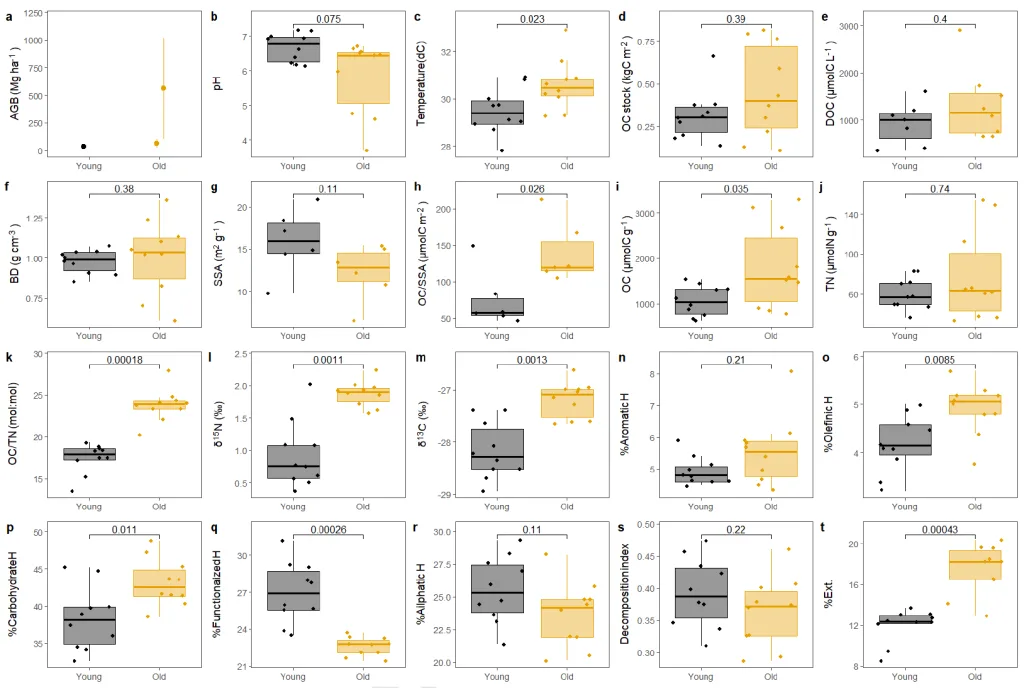
The researchers combined vegetation surveys, sediment and water measurements, stable isotope analysis, and proton nuclear magnetic resonance spectroscopy to examine carbon stocks and the chemical composition of organic matter. Older intact stands had substantially greater aboveground and belowground biomass and generally higher sediment organic carbon content. Their sediments also contained higher proportions of carbohydrate and olefinic compounds, while sediments from the restored sites were more strongly characterized by aliphatic and functionalized aliphatic compounds.
The results indicate that the amount, composition, and preservation of sedimentary carbon change as mangrove forests develop. The study provides baseline information for assessing how restored mangroves progress toward the sediment carbon characteristics observed in older intact forests.
Reference: Ray, R., Kida, M., Suwa, R., Miyajima, T., Ferrera, C. M., Rollon, R., Primavera-Tirol, Y. H., Diego-McGlone, M. L. S., & Nadaoka, K. (2026). Chemical composition of sedimentary organic carbon differs significantly between the intact and restored mangroves in the Philippines. Organic Geochemistry, 105279. https://doi.org/10.1016/j.orggeochem.2026.105279