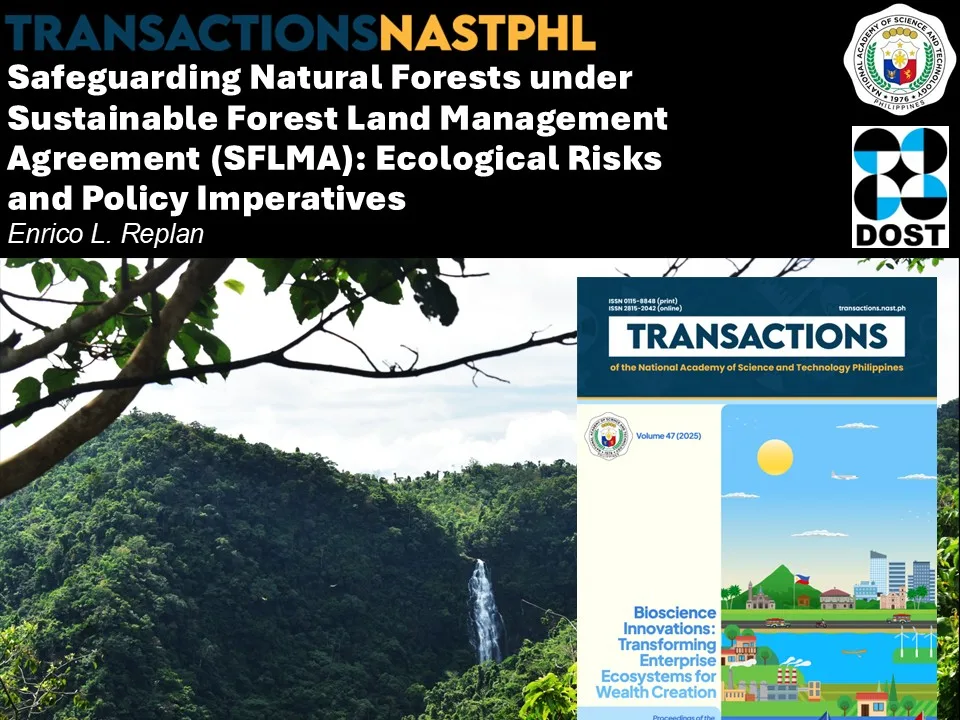
A new perspective article by Enrico L. Replan of the Institute of Environmental Science and Meteorology, UP Diliman, analyzes the ecological vulnerabilities that may arise from implementing the Sustainable Forest Land Management Agreement (SFLMA). Published in Transactions NAST PHL, the paper reviews how recent policy reforms could unintentionally accelerate the conversion of remaining natural forests into agroforestry and plantation systems, placing biodiversity, upland communities, and key ecosystem services at heightened risk .
The article outlines how habitat simplification, weakened ecological functions, and increased fragmentation may occur when diverse natural forests are replaced by production-oriented land uses. It also identifies governance gaps, including the absence of ecological baselines, limited biodiversity indicators, and potential incentives for converting intact forest patches. Replan emphasizes the need for science-based safeguards, such as delineating no-go zones, establishing biodiversity baselines, and strengthening monitoring and community participation mechanisms .
The paper underscores that while SFLMA aims to streamline forest tenure and support sustainable management, its long-term success depends on integrating ecological science into policy implementation. By proposing evidence-based safeguards, the study contributes to ongoing discussions on forest governance and highlights essential measures to protect the Philippines’ remaining natural forest ecosystems .
A copy of the article can be accessed below