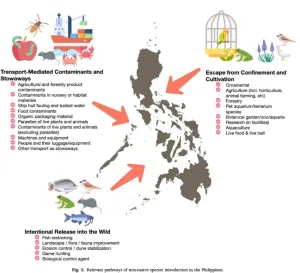
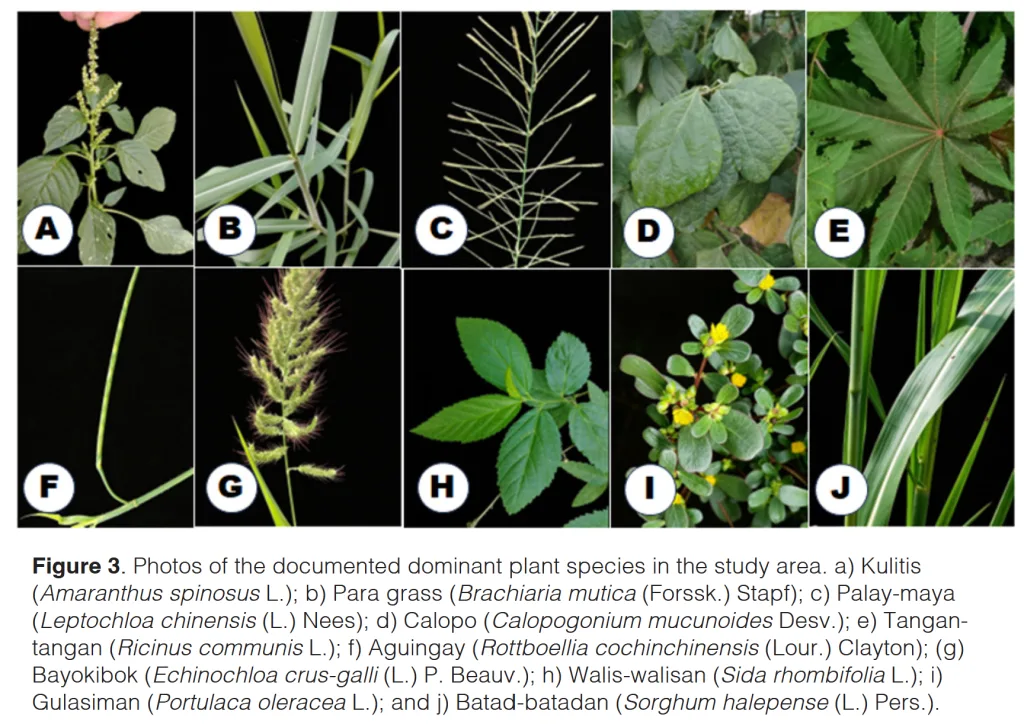
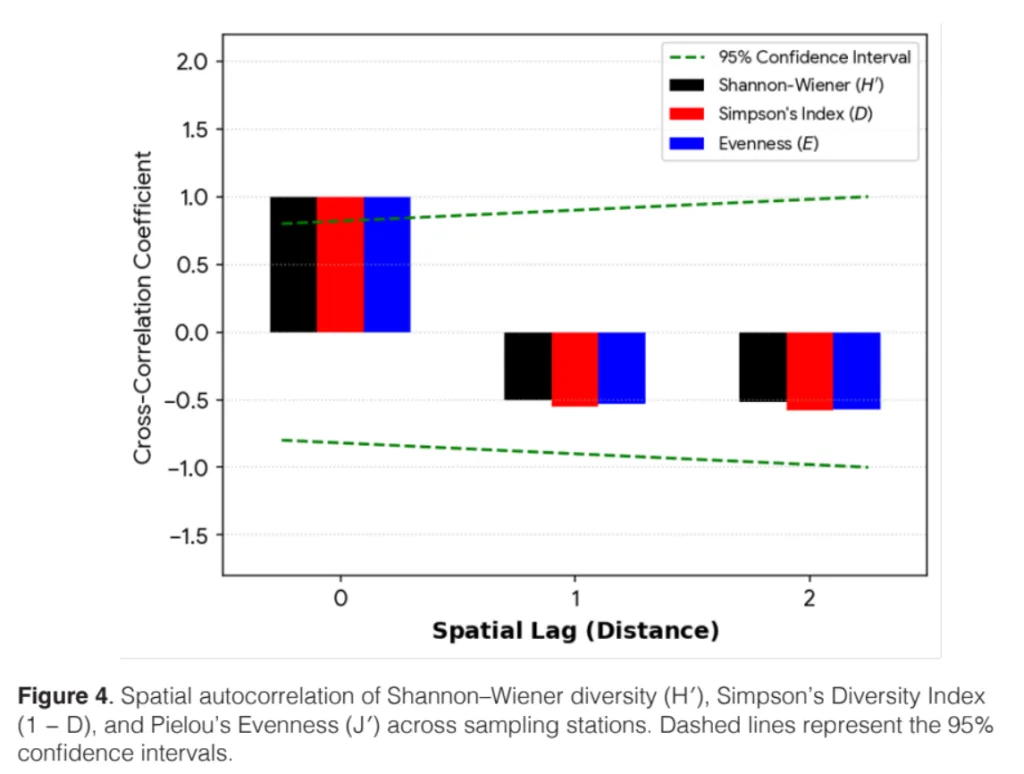
Lakeshore grasslands in Barangays San Antonio and Tagumpay, Bay, Laguna, were found to support moderately diverse plant communities dominated by grasses and other disturbance-tolerant species. In a recently published study, IESM faculty member Assistant Professor Enrico L. Replan, PhD documented 35 plant species from 18 genera and 10 families, with the grass family Poaceae forming the main structural component of the vegetation. The study also found localized variation in species composition and diversity across sampling areas, with no significant spatial autocorrelation.
Vegetation sampling was conducted in August 2025 using 28 quadrats established along five transects in the two barangays. Among the species with the highest ecological importance were Brachiaria mutica, Sorghum halepense, and Echinochloa crus-galli. Several introduced and invasive species, including Lantana camara, Cyanthillium cinereum, and Commelina diffusa, were also recorded across the study area.
Titled “Floristic composition, diversity, and spatial variation of lakeshore grassland vegetation in Barangays San Antonio and Tagumpay, Bay, Laguna, Philippines,” the study was published online on 19 August 2026 in the Ecosystems and Development Journal. The findings provide baseline information for future monitoring, conservation planning, and management of lakeshore vegetation in Laguna de Bay.
Reference: Replan, E. (2026). Floristic composition, diversity, and spatial variation of lakeshore grassland vegetation in Barangays San Antonio and Tagumpay, Bay, Laguna, Philippines. Ecosystems and Development Journal, 15(1), 62. https://doi.org/10.65355/giot6906