Dr. Enrico Replan, assistant professor at the Institute of Environmental Science and Meteorology (IESM), College of Science, University of the Philippines Diliman, published a study on how forest structure and plant species composition vary across disturbance gradients in the Lagonoy Natural Biotic Area in Camarines Sur. The article, titled “Forest structure and species composition along disturbance gradients in a Philippine natural biotic area,” was published in Forest Science and Technology.
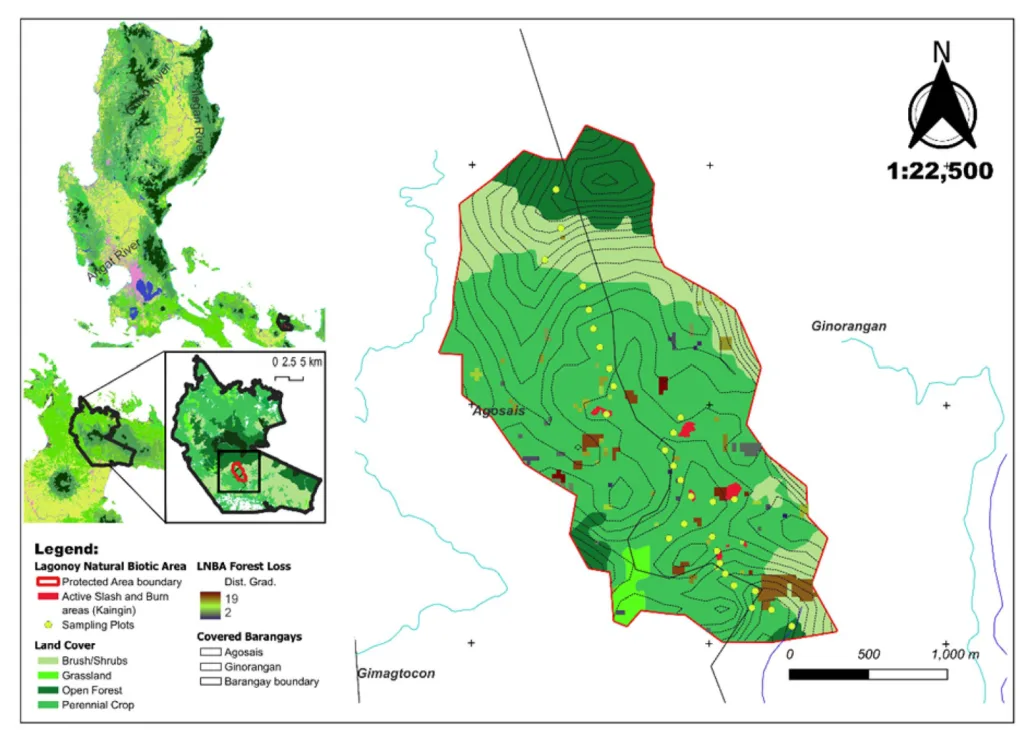
The study assessed vegetation data from 60 plots across upland and riparian forest zones, documenting species identity, abundance, stem density, basal area, and community composition. Anthropogenic pressure was evaluated using socio-spatial indicators, including accessibility, proximity to settlements and roads, forest resource use intensity, and length of nearby community residency. Results showed that areas with higher accessibility and stronger forest resource dependence had lower species diversity, reduced structural complexity, and greater dominance of disturbance-tolerant and early-successional plant species.
The findings indicate that sustained human pressure can drive measurable changes in forest structure and species composition even within protected landscapes. By combining vegetation surveys with disturbance proxy indicators, the study provides a practical framework for identifying forest degradation patterns and supporting adaptive forest management in human-inhabited tropical forest areas.
Reference:
Replan, E. L. (2026). Forest structure and species composition along disturbance gradients in a Philippine natural biotic area. Forest Science and Technology, 1–15. https://doi.org/10.1080/21580103.2026.2678274