A new study by IESM faculty members Rafaela Jane Delfino and Gerry Bagtasa, together with Pier Luigi Vidale and Kevin Hodges of the University of Reading and the National Centre for Atmospheric Science, examined how a warmer climate may affect rainfall from Typhoons Haiyan, Bopha, and Mangkhut. Using high-resolution weather models, the researchers simulated the three storms under pre-industrial, present-day, and future climate conditions.
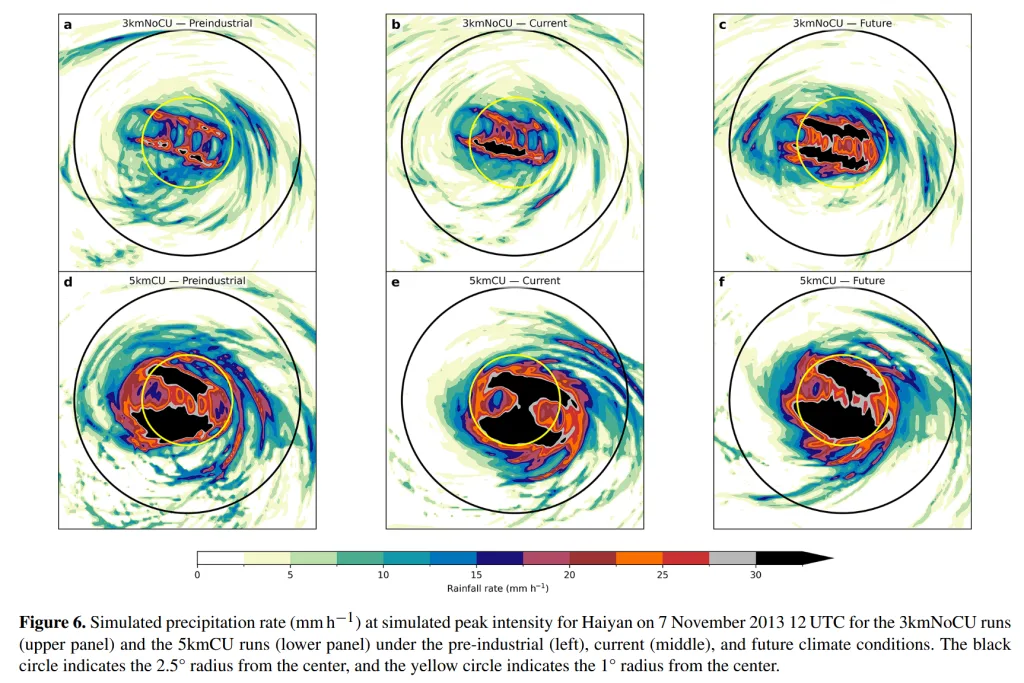
The future simulations generally produced more typhoon-related rainfall, broadly consistent with the Clausius–Clapeyron relationship, which describes how warmer air can hold more water vapor. The increase was most evident in the storms’ inner regions, where the models also showed a greater contribution from intense, short-duration rainfall.
The study found that additional atmospheric moisture was the main driver of the projected rainfall increase. However, changes in storm circulation, vertical motion, intensity, and structure also influenced the final response. These dynamic effects varied among the three typhoons and could either strengthen or partly offset the moisture-driven increase. Published in Natural Hazards and Earth System Sciences, the study helps clarify how atmospheric warming and storm-specific dynamics may jointly shape future typhoon rainfall in the Philippines.
Reference: Delfino, R. J., Bagtasa, G., Vidale, P. L., & Hodges, K. (2026). Impact of warming on rainfall changes in damaging Philippine typhoons using high-resolution convection-permitting models. Natural Hazards and Earth System Sciences, 26(7), 3579–3595. https://doi.org/10.5194/nhess-26-3579-2026